
More details
Collapse details
Date Published:
Filesize:
- May 1, 2013
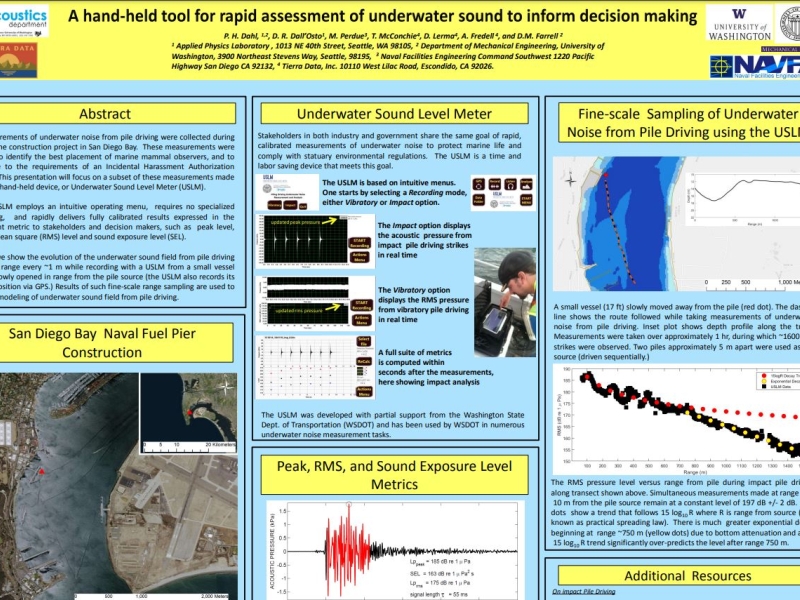
HDR, Inc. provided comprehensive monitoring services for an in-water pile driving construction project at Naval Base Kitsap Bangor, Washington. Using highly trained marine species observers, field technicians, and acousticians, we ensured client compliance in the face of complex regulatory requirements.
- 194.34 KB
Effects of Pile Driving on Marine Mammal Behavior in Puget Sound, Washington, USA.
ESOMM - 2014 5th International Meeting on the Effects of Sound in the Ocean on Marine Mammals .
More details
Collapse details
Date Published:
Filesize:
- September 7, 2014
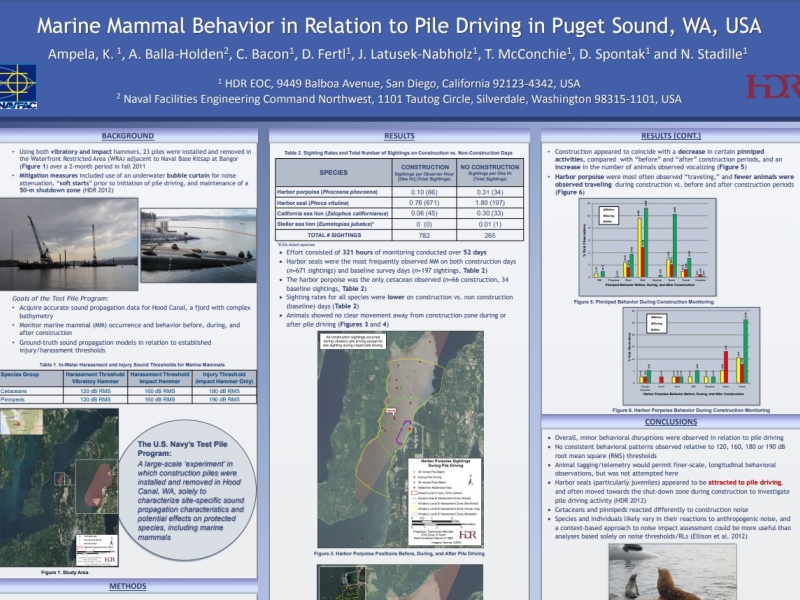
Marine mammal (MM) monitoring was conducted during in-water pile driving (PD) at Hood Canal, Washington, during fall 2011. Monitoring was performed on construction days, during active-construction (“AC”, defined as 30 minutes prior to, during, and 30 minutes after PD) and non-construction (“NC”, downtime) periods. Baseline surveys were also conducted throughout Hood Canal on days when no PD occurred. Monitoring and baseline surveys occurred over 53 days. Marine Mammal Observers (MMOs) recorded 1,207 sightings totaling 2,269 individual MM.
- 1,481.12 KB
Marine Mammal Behavior in Relation to In-Water Pile Driving in Puget Sound, Washington, USA..
20th Biennial Conference on the Biology of Marine Mammals .
More details
Collapse details
Date Published:
Filesize:
- December 9, 2013
Marine mammal (MM) monitoring was conducted during inwater pile driving (PD) at Naval Base Kitsap Bangor, Washington in Hood Canal during Fall 2011. Vessel-based monitoring was performed on construction days, during both active-construction (“AC”, defined as 30 minutes prior to, during, and 30 minutes after PD) and non-construction (“NC”, downtime) periods. Baseline surveys were also conducted throughout Hood Canal on days when no PD occurred. Monitoring and baseline surveys occurred over 53 days, during which Marine Mammal Observers (MMOs) recorded 1,207 sightings totaling 2,269 individual MM. Species observed included California sea lion (Zalophus californianus), Steller sea lion (Eumetopias jubatus), harbor seal (Phoca vitulina), and harbor porpoise (Phocoena phocoena). Harbor seals were the most frequently observed MM on construction days (n=782 sightings) and baseline survey days (n=197 sightings). The only cetaceans observed were harbor porpoise (n=68 construction, 34 baseline sightings). Harbor seal sighting rates were lower on construction days than on baseline days (0.73 and 1.80 sightings/observer hour [obs hr], respectively). Likewise, harbor porpoise were sighted less often on construction days than on baseline days (0.13 and 0.31 sightings/obs hr, respectively). On construction days, harbor seal sighting rates were actually higher during AC periods than NC periods (3.31 and 0.23 sightings/obs hr, respectively). This is consistent with MMOs’ qualitative observations that harbor seals (particularly juveniles) appeared to be attracted to PD, and often moved towards the construction area when PD was initiated. On construction days, pinnipeds were most often observed “diving,” “looking,” “sinking,” and “swimming”. During AC, 4% more pinnipeds were observed “diving” vs. NC periods (n=124). On construction days, harbor porpoise were most often observed “traveling”. During AC, 27% fewer harbor porpoise were observed “traveling” vs. NC periods (n=18). Overall, minor behavioral disruptions were observed in relation to PD, and were within “take” numbers in the issued Incidental Harassment Authorization.
- 4,632.51 KB
More details
Collapse details
Date Published:
Filesize:
- December 18, 2023
This survey implemented visual line transect and passive acoustic methods to assess the presence and distribution and to estimate density and abundance of cetaceans in Behm Canal and central Clarence Strait.
- 1,093.33 KB
More details
Collapse details
Date Published:
Filesize:
- June 1, 2014
This report summarizes information from 24 U.S. Navy-funded aerial surveys of pinniped haulout sites in the inland waters of Washington State conducted between March 2013 and February 2014 by Washington Department of Fish and Wildlife.
- 2,946.44 KB
More details
Collapse details
Date Published:
Filesize:
- June 1, 2013
The objectives of this TO are to conduct aerial surveys of the study area in order to: 1) provide estimates of seasonal abundance for seals and sea lions, 2) identify seasonal distribution patterns for seals and sea lions, 3) collect data to determine seal and sea lion densities, and 4) provide harbor seal abundance data needed by NMFS to prepare a Stock Assessment Report (SAR) for the Washington inland waters harbor seal stock. Additionally, the atlas showing pinniped haulouts for these waters (Jeffries et al. 2000) has not been updated in 13 years and will be revised as well.
- 1,959.27 KB
More details
Collapse details
Date Published:
Filesize:
- April 1, 2009
During this project, the visual survey covered a total of 760 kilometers (410 nautical miles) on-effort while transit and fog effort legs accounted for 553 km (298 nm). There were a total of 96 sightings (453 individuals) of 11 confirmed marine mammal species; these included fin, humpback, gray, and minke whales as well as killer whales, Dall’s and harbor porpoise, Pacific white-sided dolphins and Steller sea lions, harbor seals and sea otters. Additionally, there were 36 sightings (46 individuals) of unidentified large whales, dolphins and pinnipeds. Acoustically, operations were conducted 24-hours/day surveying a total of 3,519 km (1,900 nm) and recording 49 acoustic detections of sperm whales and killer whales. Photographs of nineteen individual killer whales and four fin whales were obtained on this cruise and compared to existing catalogs.
- 1,894.30 KB
More details
Collapse details
Date Published:
Filesize:
- June 1, 2017
From 2013 to 2016, we conducted systematic line-transect aerial surveys in 8 sub-regions of Puget Sound encompassing inland waters of Washington State. U.S.-funded surveys were conducted year-round and focused on estimating seasonal in-water density and abundance of marine mammals, particularly harbor porpoises and harbor seals
- 4,652.56 KB
More details
Collapse details
Date Published:
Filesize:
- December 31, 2015
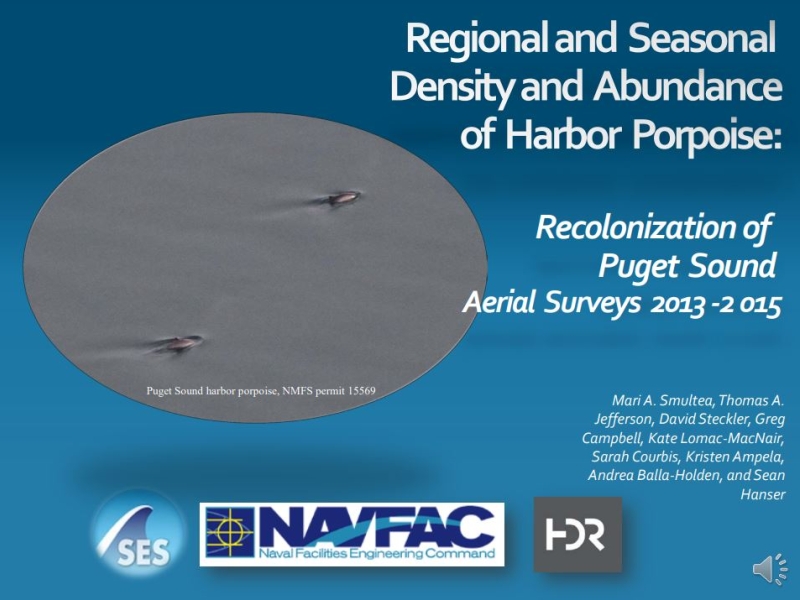
From 2013 to 2015, researchers conducted systematic line-transect aerial surveys for marine mammals in eight subregions of Puget Sound encompassing inland waters of Washington State. Effort consisted of five separate survey periods spanning four seasons (winter, spring, summer and fall) and was funded by the United States Navy (Navy). Surveys focused on estimating seasonal in-water density and abundance of cetaceans, particularly harbor porpoise (Phocoena phocoena).
- 5,860.87 KB
Puget Sound marine mammal aerial surveys, 2013-2015.
Marine Mammal Working Group, Puget Sound Ecosystem Monitoring Program (PSEMP) .
More details
Collapse details
Date Published:
Filesize:
- January 15, 2015
Seasonal systematic aerial surveys of Puget Sound.
- 5,672.86 KB
More details
Collapse details
Date Published:
Filesize:
- August 6, 2025
The Alaska Fisheries Science Center (AFSC), NOAA Fisheries, with support from the U.S. Navy, conducted line transect surveys in Behm Canal and adjacent areas in the spring of 2023 and fall of 2024 to obtain estimates of density and abundance of cetaceans and information on marine mammal distribution and occurrence.
- 9,210.00 KB
Complete
Acoustic and Visual Survey for Cetaceans in Behm Canal and Southern Clarence Strait, Alaska
Project Objectives
Conduct visual line-transect surveys and passive acoustic monitoring for cetaceans, and other marine mammals, to determine species occurrence, and to estimate density within Navy’s testing range. Acoustic monitoring devices will be deployed during the vessel based survey, and long-term passive acoustic hydrophones will be monitored for year-round detection of rare and/or cryptic cetacean species.
Complete
Acoustic Tagging of Green Sturgeon to Evaluate Habitat Use Along the Washington Coast
Project Objectives
With acoustic telemetry, determine 1) the location of green sturgeon detections within Washington, 2) the season for specific habitat use (e.g., estuaries; coastal waters), 3) the frequency an animal moves between coastal and estuarine waters, and 4) the range of each tagged animal.
Complete
Aerial Surveys of Marine Mammals Conducted in the Inland Puget Sound Waters of Washington, summer 2013 – winter 2016
Project Objectives
1) Conduct aerial surveys during four seasonal periods within the inland Puget Sound Survey Area to assess potential differences in seasonal distribution, numbers, and behavioral state patterns of marine mammals; 2) Collect data to estimate densities of marine mammals in the inland Puget Sound waters for species with sufficient sightings; 3) Estimate abundance for each marine mammal species seen an adequate number of times; 4) Document the distribution and habitat use of each species observed; 5) Document and describe behaviors seen without performing focal follows.
Complete
Characterizing the Distribution of ESA-listed Salmonids in Washington and Alaska
Project Objectives
Use acoustic tagging technology to provide critical information on spatial and temporal distribution of salmonids to inform salmon management, U.S. Navy activity, and Southern Resident Killer Whale (SRKW) conservation. The study seeks to 1) determine the occurrence and timing of salmonids within the Navy training ranges, 2) describe the influence of environmental covariates on salmonid occurrence; and, 3) describe the occurrence of salmonids in relation to SRKW distribution.
Complete
Guadalupe Fur Seal Satellite Tracking
Project Objectives
Determine the at-sea distribution of endangered Guadalupe fur seals and whether they travel through or utilize the offshore waters of the Southern California Range Complex and Northwest Training and Testing area
Current
Monitoring Cetaceans in Hood Canal
Project Objectives
This 12‑month integrated pilot project combines three complementary components: (A) shore‑based theodolite monitoring of harbor porpoises, (B) high‑bandwidth passive acoustic monitoring and soundscape characterization, and (C) suction‑cup multi‑sensor tag deployments on Bigg’s (transient) killer whales. Together, these data streams will quantify occurrence, movement, diving, and behavioral context for these two key species in relation to the local soundscape—including operational signals near the Dabob Bay Range Complex (DBRC) and the Bangor Trident Base. Results can provide an empirical foundation and inform the study design of future cetacean behavioral response studies (BRS) in Hood Canal.
Complete
North Pacific Humpback Whale Tagging
Project Objectives
Determine the occurrence, movement patterns, and residency patterns of multiple humpback whale Distinct Population Segments within Pacific Ocean Navy Range Complexes
Current
North Pacific Marine Mammal Species Distribution
Project Objectives
Develop a North Pacific-wide species distribution model for cetaceans
Complete
Occurrence of Green Sturgeon in Inland Waters (historical tag analysis)
Project Objectives
Compile green sturgeon tag and receiver data and analyze historical data for occurrence, distribution, and seasonality in Puget Sound and the Straits of Juan de Fuca
Complete
Offshore Distribution of Southern Resident Killer Whales in the Pacific Northwest
Project Objectives
1) Identify and classify Southern Resident killer whale (SRKW) detections from acoustic recorders and satellite tag tracking; 2) Develop a model to estimate the seasonal and annual occurrence patterns of southern resident killer whales relative to offshore Navy training ranges. 3) Characterize occurrence of anthropogenic sounds in potential SRKW habitat. 4) Develop state space habitat model for SRKW prey, based on fall Chinook salmon tagged released from California to British Columbia between 1977 and 1990 to estimate seasonal distribution along the west coast.
Current
Pacific Marine Assessment Program for Protected Species (PACMAPPS) survey
Project Objectives
Identify species of beaked whales, odontocetes, and baleen whales that occur in the surveyed areas; Monitor marine mammal and sea turtle presence, distribution, and diversity in offshore waters; Develop a better understanding of marine mammal distribution, movement patterns, habitat use, population structure, and abundance; Develop reference library of visually-validated acoustic recordings of marine mammals.
Current
Passive Acoustic Monitoring of Harbor Porpoises in Hood Canal
Project Objectives
This project was jointly funded through NAVSEA and the NUWC Keyport NISE program to address the Navy’s need for multi-year data on harbor porpoise occurrence and spatiotemporal distribution patterns in Hood Canal using passive acoustic monitoring (PAM).
Current
Salmonid and Southern Resident Killer Whale Distribution in the Pacific Northwest
Project Objectives
1) Determine the occurrence of bull trout within and near the boundaries of the NWTT; 2) Determine the spatiotemporal occurrence of killer whale and baleen whale in the NWTT; 3) Characterize the occurrence of endangered fish species within the NWTT
Complete
Satellite Tagging and Behavioral Monitoring of Male California Sea Lions in the Pacific Northwest to Assess Haul-out Behavior on Puget Sound Navy Facilities and Foraging Behavior in Marine Navy Testing and Training Areas
Project Objectives
To determine the abundance and habitat use of California sea lions that haul out at Navy facilities and forage in testing and training areas
Complete
Vessel-based Marine Mammal Surveys in Puget Sound, Washington
Project Objectives
Conduct marine mammal in-water vessel-based line transect surveys in the Puget Sound basin to: 1) Record data on all marine mammal species seen with the study area, with a focus on the killer whale (Orcinus orca) and the harbor porpoise (Phocoena phocoena). 2) Identify the seasonal occurrence and abundance/density of cetaceans within the study area. 3) Identify the effects of environmental variables on the distribution and abundance of species in the study area.No related blog posts to display